

Malaysia’s crackdown on the MBI investment scam has accelerated sharply in 2025, with a series of high-profile arrests and massive asset seizures underscoring the true scale of what authorities now describe as one of the largest financial fraud cases in the region.
Datuks, Proxies, and Nearly RM100 Million More Seized
On August 22, 2025, Inspector-General of Police Datuk Seri Mohd Khalid Ismail announced the arrest of six individuals linked to the MBI network by the Bukit Aman Anti-Money Laundering Investigation Team (AMLA). Among them were:
- A “Datuk Seri” who owns companies listed on Bursa Malaysia
- Two other “Datuks” involved in telecommunications and property development
- An accountant and a durian farm caretaker, believed to be part of the fund flow structure
Authorities revealed that most of the suspects are believed to have acted as proxies, receiving funds from overseas and channeling them into Malaysian assets – including property, agriculture, and businesses – before reporting the money as legitimate company profits.
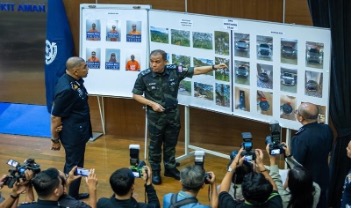
In the latest operation alone, police:
- Froze and seized 88 bank accounts totalling RM10.52 million
- Seized 398.8 million shares worth about RM86.86 million
- Confiscated cash, luxury vehicles, watches, handbags, phones, and documents
- Total value seized in this single operation: ~RM97.7 million. Cumulative assets frozen to date: ~RM6.6 billion
The True Scale Comes Into Focus
By June 2025, government officials disclosed the staggering cross-border impact of the scheme:
- The MBI Ponzi operation is believed to have defrauded over two million victims in China, involving more than 55 billion yuan (≈ RM32.4 billion).
The scheme allegedly used classic Ponzi mechanics — paying earlier investors with funds from new participants — until the entire structure collapsed.
Properties, Yachts, Companies — The Asset Trail Widens
Earlier, on May 30, 2025, police announced they had seized and frozen an additional RM527.5 million in assets, pushing the total recovery at that time to RM3.8 billion.
The haul included:
- 477 properties worth ~RM150 million
- Luxury condominiums, yachts, and passenger boats
- 37 bank accounts containing ~RM328 million
- Cash, luxury vehicles, watches, jewellery, and documents
- Five business entities, including a durian plantation company, a property developer, and a hotel operator

A Nationwide Dragnet Takes Shape
Under the same ongoing operation targeting financial syndicates in the Klang Valley and northern Peninsular
Malaysia, authorities have so far:
- Arrested 17 individuals
- Frozen 988 bank accounts
Investigators believe these suspects form part of a cross-border, Ponzi-style investment network linked to MBI’s broader ecosystem.
Pilgrimage Scam Prevention
Authorities also announced the formation of a special task force at KLIA to combat Haj package fraud during the pilgrimage season, following reported losses of RM874,100 across four cases so far this year.
While the MBI case remains the largest, Malaysian authorities have simultaneously widened their crackdown on organised financial crime across the country — revealing just how industrialised scam operations have become.

The Rise of Scam “Call Centres”
In a parallel operation on May 13, police dismantled two phone scam syndicates targeting Japanese nationals in Kajang and Cheras, seizing electronic equipment worth approximately RM25,000.
In Kajang, police raided a three-storey bungalow used as a fake call centre:
- Eight suspects arrested (six Japanese, two Chinese)
- Syndicate members impersonated Osaka police using call-spoofing software
- Two Chinese suspects have been charged; the six Japanese suspects are scheduled to be charged in early June
In Cheras, a second raid led to:
- 11 arrests (seven Japanese, three Taiwanese)
- Seizure of laptops, mobile phones, fake police uniforms, and documents.
- Three Taiwanese suspects have been charged; the rest are now prosecution witnesses

Dubbed by Chinese media as “Asia’s godfather of pyramid schemes”, the 59-year-old Teow is no stranger to controversy. His career has been marked by repeated reinvention — and repeated collapse.
From Red Cafe to Reinvention
Teow’s first major brush with the law came in 2009 with Island Red Cafe, a so-called franchising business that raised funds by promising high returns. The venture collapsed within 18 months.
In 2011, Teow and his son were convicted of cheating and misleading investors, involving more than RM1 million. Both were sentenced to a day in jail and fined RM160,000.
It would not be the last time.

MBI: A Property Company That Wasn’t
In the same period, Teow founded MBI — Mobility Beyond Imagination. Publicly, it presented itself as a property development group, claiming involvement in luxury residential and retail projects in Malaysia and Danok, Thailand.
But the property narrative was merely a façade.
 The Birth of M-Coin and the MFC Machine
Three years later, MBI launched what would become the core of its operation:
“A pyramid-style system known as MFC, marketed as a digital economy powered by its own currency – M-Coin.”
Participants were told:
- They could earn high returns
- M-Coin could be used as payment at MBI- affiliated outlets
- The system represented a new “digital financial ecosystem”
In reality, authorities would later allege it was a classic closed-loop Ponzi structure.
What began in Malaysia soon expanded far beyond its borders into China, Taiwan, Japan, and New Zealand
— laying the groundwork for what would eventually become one of the largest cross- border financial scams in the region.
Red Cafe failed. MBI was bigger. MFC was bolder.
But the formula remained the same: Sell a story. Promise returns. Use new money to pay old participants. Scale fast.
Only this time, the numbers ran into the tens of billions.

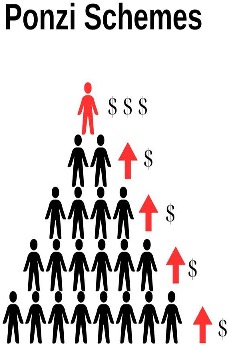
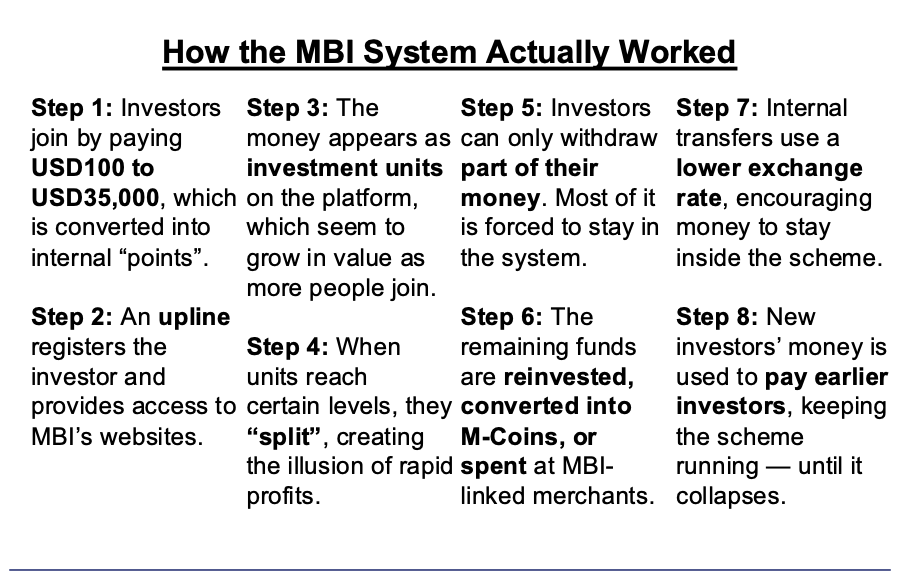
An infographic published by The Edge outlined the scheme as an eight- step money machine designed to look like an investment platform — while functioning like a classic Ponzi structure.
From Spectacle to Silence: The Rise and Fall of M Mall
Investigators say the MBI scheme began in 2012 and rapidly expanded beyond Malaysia by 2016, reaching Taiwan, Japan, and New Zealand — though its primary target was always China.

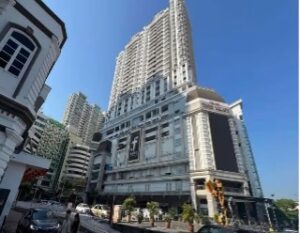
Locals still remember luxury cruise ships docking at the Penang jetty, unloading hundreds of Chinese tourists who were then bused directly to Penang Times Square in Georgetown — later rebranded as “M Mall.” There, visitors were encouraged to spend M-Coins on mobile phones, handbags, cosmetics, and other goods inside a tightly controlled ecosystem.

MBI began to unravel in 2017 when Bank Negara Malaysia led raids on its offices, seizing cash, luxury vehicles, and freezing bank accounts. However, the amount recovered was tiny compared to the estimated RM30
billion allegedly taken.
In 2018, Teow, his son, and related parties were fined RM20 million, a move that angered many Chinese victims who felt justice was not served.
Despite the scandal, Teow continued moving between Penang and southern Thailand, backed by strong local connections.
By 2019, the case became a diplomatic embarrassment when Chinese victims protested outside the Chinese Embassy in Kuala Lumpur, accusing Malaysia of inaction.
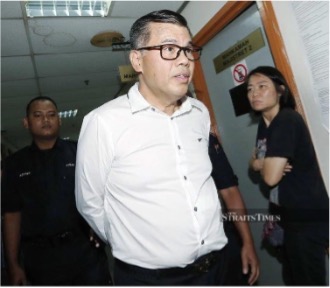
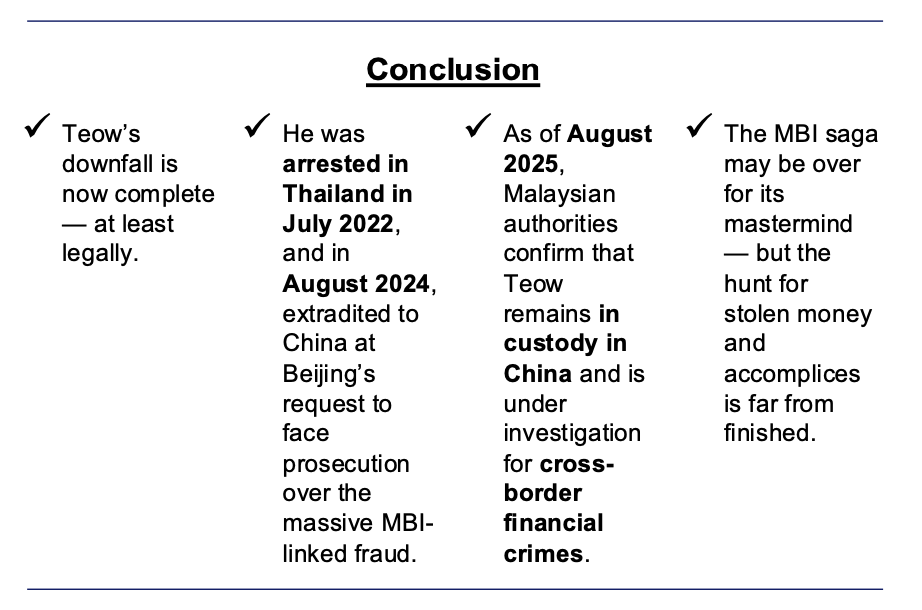
In 2020, China escalated the matter by securing an Interpol Red Notice against Teow. Still, nothing happened until July 2022, when Thai police finally arrested him in Songkhla for allegedly running an illegal online casino.
- Teow’s arrest in Thailand sparked a quiet tug-of-war between Malaysia and China over who would take custody of him.
- Both countries sought his extradition, but China mounted a stronger case. In August 2024, Thai authorities approved his transfer to Beijing.
- According to Chinese media, Teow — also known as Zhang Yufa— was extradited under Operation “Fox Hunt”, China’s global campaign to track down financial crime suspects. He became the first person in 25 years to be extradited from Thailand to China.
- His detention in China has revived the MBI scandal, reminding many Malaysians that the case is far from over.
- Officials say Malaysia and China are now working more closely, focusing first on tracing stolen funds and identifying those who helped move and hide the money. Recovering victims’ losses will be complex and time-consuming.
Source:
- https://www.malaymail.com/news/mal aysia/2025/08/22/datuk-seri-and-two- datuk-businessmen-linked-to-bursa-listed-firms-among-six-nabbed-in-mbi- international-investment-fraud-case-igp-says/188537
- https://www.channelnewsasia.com/asia/malaysia-china-crackdown-mbi-scam- money-laundering-tedy-teow-wooi-huat-5171136
- https://www.malaymail.com/news/mal aysia/2025/05/30/mbi-investment- scam-crackdown-477-properties-rm328m-frozen-as-cops-nab-tan-sri-in-billion- ringgit-bust/178699
- https://says.com/my/news/whats-mbi-ponzi-scam-key-facts-the-rm3-billion- seized-assets-case
- https://www.facebook.com/groups/penangtoday/posts/2938802152937679/
- https://www.scmp.com/weekasia/people/article/3314016/us900-million-seized-china-helps-malaysia-dismantle-tedy-teows-scam-empire

The MBI scandal proves a timeless truth: high returns without transparency and regulation usually end in disaster. Behind impressive marketing and “legitimate” fronts, there were no real assets and no real oversight.
At Core Advisors (CA), our philosophy is built on discipline, rigorous due diligence, and trust. We help clients diversify their portfolios through properly structured, regulated, and transparent investment strategies.
The lesson is simple:
If something sounds too good to be true, it usually is.
Always verify the investment. Always consult a trusted advisor.
At Core Advisors, we believe wealth is built through disciplined decisions and protected by sound governance and professional management.
Wealth is not only about growing returns — it is also about protecting capital and ensuring it is placed within sound, transparent, and properly governed structures. The MBI case is both a cautionary tale and a powerful reminder of the importance of disciplined decision-making and proper investment oversight.
With the right advisors like Core Advisors, and the right structures — including well-governed investment platforms and robust legal and compliance frameworks — investors can safeguard their wealth and avoid costly mistakes.
Discover more about Core Advisors Limited and the services it provides

MBI investment scam – When the Media Names You ‘Jho Low 2’
Malaysia’s crackdown on the MBI investment scam has accelerated sharply in 2025, with a series of high-profile arrests and massive asset seizures underscoring the

The Heir Who Built Beyond the Waves: Hui Sai Fun’s Journey from Shipping Fortune to Real Estate Empire
Part I: Foundation and Transformation: From Son of the “King of Ships” to Real Estate Tycoon The story of Hui Sai Fun begins with his

The Family Feud Over Wang Yung-Ching’s Fortune; And What We Can Learn From It
Introduction Wang Yung-Ching, known as the “God of Management” in Taiwan, was the legendary founder of Formosa Plastics Group, a sprawling business empire spanning petrochemicals,

Do You Really Need Investment Advisor Services? Here’s How to Decide
The internet is full of information about how to increase your wealth and secure your financial future. However, the more information there is, the more

Top Mistakes People Make Without an Experienced Wealth Management Advisor
When it comes to wealth management, the temptation of quick online tips and DIY solutions can be strong. But in the absence of the knowledge

How Wealth Management Planning Evolves as You Grow Your Wealth
Money is not stagnant and neither should your financial management plan be. At Core Advisors Ltd., we believe that wealth management planning is an ongoing